




Industria | 16.07.2026
The Invisible Enemy of Machining: How Heat Limits Your CNC Performance
By: HEMAQ
16.07.2026
Share

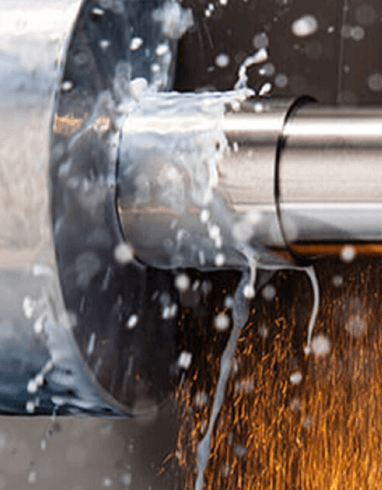
In every machining process, there is a factor that is rarely visible but has a direct impact on productivity, part quality, and operating costs: the heat generated in the cutting zone.
As the cutting tool interacts with the material, friction generates temperatures that can exceed 300°C (572°F), concentrating precisely where the tool performs the cutting operation. At these temperatures, conventional coolant loses much of its ability to protect the process, accelerating tool wear and reducing machining performance.
Why Conventional Coolant Is No Longer Enough
In standard-pressure coolant systems (100 to 300 psi), the coolant often evaporates before it reaches the point where it is needed most. As a result, the cutting tool operates under unfavorable thermal conditions.
When heat remains concentrated in the cutting zone, several issues arise that directly impact production:
- Accelerated wear of inserts and cutting tools.
- Formation of long chips that are difficult to evacuate.
- Inconsistent surface finishes.
- Increased machine downtime due to more frequent tool changes.
- Higher risk of scrap and rework.
In other words, heat doesn’t just affect the cutting tool—it compromises the stability of the entire machining process.
The Difference Is Reaching the Cutting Zone
High-pressure coolant systems completely change the way coolant interacts with the machining process.
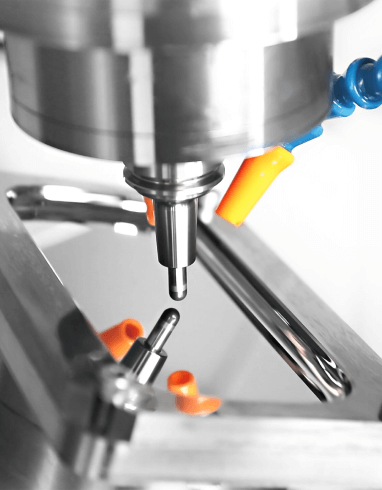
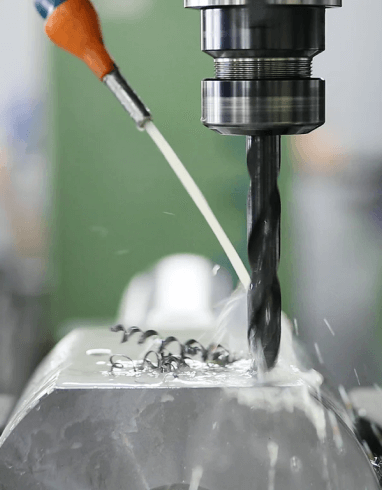
Operating at pressures of 1,000 psi or higher, the coolant is able to penetrate directly between the cutting tool and the workpiece, even in areas that conventional systems cannot reach.
This targeted delivery provides significantly more efficient cooling by rapidly dissipating the accumulated thermal energy and maintaining a stable temperature at the cutting edge. In addition, the force of the coolant helps break chips into smaller pieces, making chip evacuation easier before they can interfere with the cutting tool.
Lower Temperatures Mean Higher Productivity
When heat is no longer a limiting factor, the benefits are reflected across virtually every machining performance indicator.
Extended Tool Life
By significantly reducing temperatures in the cutting zone, premature wear on inserts and cutting tools is minimized. Depending on the application, tool life can increase by up to 13 times, substantially lowering tooling replacement costs.
Improved Chip Control
Short, broken chips are easier to evacuate, reducing chip packing, preventing damage to the workpiece, and minimizing unnecessary machine downtime.
Superior Surface Finish
A cutting tool operating at a controlled temperature maintains a more consistent cutting geometry, resulting in improved surface finish and greater dimensional accuracy.
Faster Machining Processes
With effective thermal control, cutting speeds and feed rates can often be increased by 20% to 30%, reducing cycle times without compromising machining quality.
Thermal Control Also Improves Profitability
Although high-pressure coolant systems are often associated primarily with lubrication, their greatest contribution is effective temperature control throughout the machining process.
Reduced tool wear, fewer tool changes, lower scrap rates, and more stable production frequently allow manufacturers to achieve a return on investment in less than 12 months across many industrial applications.
Turning Heat into a Competitive Advantage
In manufacturing, controlling heat means controlling the process.
High-pressure coolant systems deliver coolant precisely where the greatest thermal load is generated, improving lubrication, enhancing chip evacuation, and protecting cutting tools throughout the entire machining cycle.
When temperature is no longer a limitation, productivity increases, quality remains consistent, and the cost per part decreases.
At HEMAQ, we help our customers integrate high-pressure coolant solutions that optimize the performance of their machining centers, enabling them to produce more parts with greater process stability and lower operating costs.
For more information, visit hemaq.com.
 Thumb blog
 Industria
Industria
Technology
11.06.2024
ECO SUITE PLUS: the innovative eco-friendly system from OKUMA
 Thumb blog
 Industria
Technology
28.04.2026
OKUMA MULTUS U1000 / U2000: Multitasking CNC Machines Redefining High-Precision Machining.